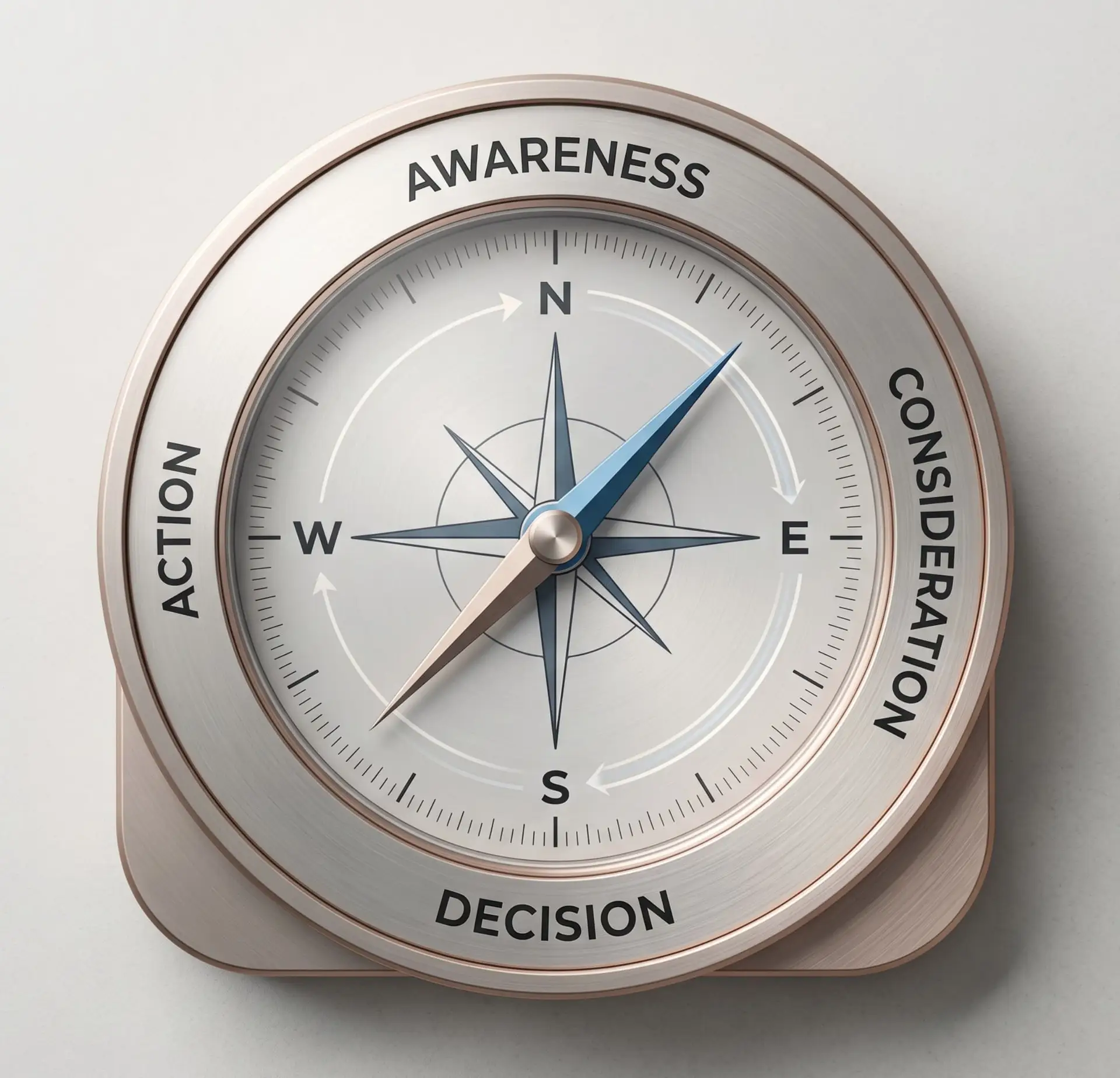
Creating Content for Different Stages of the Buyer Journey
30 April 2026 by Mike Rose
There is a persistent belief in digital marketing that more content equals better results. Publish consistently, stay visible, keep feeding the algorithm – and success will follow. In practice, it is rarely that simple.
Many businesses produce content regularly, yet see inconsistent engagement, low conversion rates, and little meaningful return. The issue is not always quality. Often, it is context. Content is created without a clear understanding of who it is for at that moment, and what that person actually needs.
This is where the buyer journey becomes invaluable. It provides a framework, not for limiting creativity, but for sharpening it. When content is aligned with where a user is in their decision-making process, it becomes more relevant, more persuasive, and ultimately more effective.
Without that alignment, even well-written content can feel misplaced – like offering a detailed sales pitch to someone who has only just realised they have a problem.
Seeing the Buyer Journey as a Strategic Lens
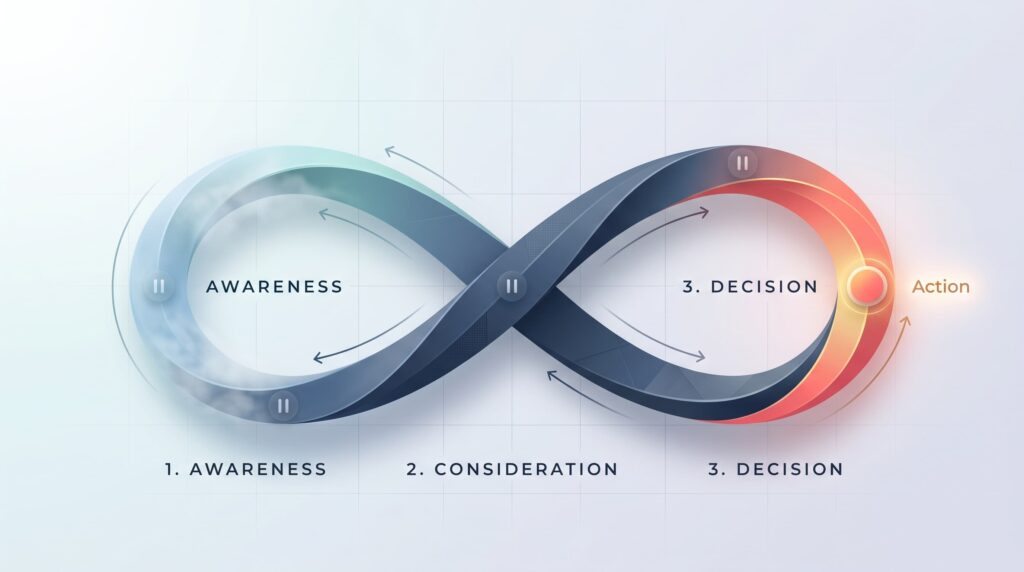
The buyer journey is typically broken into three broad stages – awareness, consideration, and decision. While these stages are often presented as a neat progression, real behaviour is rarely so linear. People move back and forth, pause, reassess, and revisit earlier thoughts.
Still, the framework remains useful because it highlights something fundamental – user intent evolves. What someone needs at the beginning of their journey is very different from what they need at the end.
At the awareness stage, they are exploring. At the consideration stage, they are evaluating. At the decision stage, they are choosing.
Effective content meets users at each of these points without rushing them. It does not try to force progression. Instead, it builds momentum gradually, allowing trust and understanding to develop at a natural pace.
Awareness Stage – Earning Attention Without Selling
At the awareness stage, users are not looking to buy. They are trying to understand something – a problem, a challenge, or a gap they have identified. This is where many content strategies falter, because they attempt to introduce solutions too early.
Content at this stage should feel informative, not transactional. It should educate, clarify, and expand the reader’s perspective. Think of it as opening a door rather than closing a deal.
The most effective awareness content often answers questions the user has not yet fully articulated. It frames problems in a way that feels insightful, offering clarity without overwhelming detail. It builds credibility subtly, positioning the brand as knowledgeable without appearing self-serving.
When done well, this type of content does more than attract attention. It establishes the first layer of trust, which is far more valuable than a premature sales message.
Consideration Stage – Building Trust Through Depth
Once a user moves into the consideration stage, their mindset shifts. They are no longer just exploring, they are comparing. They want to understand their options, evaluate approaches, and determine what might work best for them.
This is where content needs to evolve. Surface-level insights are no longer enough. Users are looking for substance, for detail, for reassurance that they are making an informed decision.
Content at this stage should provide clarity rather than complexity. It should explain not just what is possible, but how different solutions work, what their advantages are, and where they might fall short. This is also where positioning becomes important. Subtly, without overt promotion, the content should begin to differentiate your approach.
Trust deepens here. The more transparent and informative the content feels, the more confident the user becomes. They begin to see the brand not just as a source of information, but as a credible option.
Decision Stage – Removing Doubt and Encouraging Action
By the time a user reaches the decision stage, they are close to taking action. They understand their problem, they have explored their options, and they are narrowing their focus. At this point, the role of content changes again.
It is no longer about education in the broad sense. It is about reassurance. Users want to feel certain that they are making the right choice, that the business they engage with is capable, reliable, and aligned with their needs.
Content here should be clear, confident, and direct. It should reinforce key benefits, address lingering concerns, and make the next step feel straightforward. Ambiguity becomes a risk at this stage. If users are left with unanswered questions, even small ones, hesitation can quickly creep in.
This is also where calls to action carry the most weight. They should feel like a natural progression, not a push. When content has done its job effectively, the decision to act feels logical, even inevitable.
The Cost of Getting It Wrong
When content does not align with the buyer journey, its effectiveness drops significantly. This misalignment is often subtle, but its impact is not.
Overly promotional content at the awareness stage can feel intrusive, pushing users away before trust has been established. Conversely, overly generic content at the decision stage can feel unconvincing, failing to provide the clarity needed to take action.
In both cases, the issue is not necessarily the content itself, but its timing. Delivered at the wrong stage, even strong messaging loses its power.
This is why strategy matters. Content should not exist in isolation. It should be part of a broader journey, guiding users from initial interest through to confident decision-making.
Building a Connected Content Ecosystem
The most effective content strategies are not built around individual pieces. They are built around journeys. Each piece of content plays a role, connecting to others in a way that feels natural and intentional.
Awareness content draws users in. Consideration content deepens their understanding. Decision content converts that understanding into action. When these elements work together, the result is not just engagement, but progression.
This requires planning. It requires an understanding of how different content types interact, and how users move between them. It also requires consistency, both in messaging and in quality. A fragmented approach, where content varies widely in tone or intent, can disrupt the journey and weaken its impact.
When executed well, however, this ecosystem becomes a powerful asset. It nurtures users over time, building trust gradually and positioning the brand as a natural choice.
Strategy Always Outperforms Volume
There is nothing inherently wrong with producing a high volume of content. But volume without direction is rarely effective. It creates noise rather than clarity, activity rather than progress.
The real advantage comes from intention. From understanding who the content is for, where they are in their journey, and what they need at that moment.
When content is aligned with the buyer journey, it becomes more than just a marketing tool. It becomes a structured pathway, guiding users from curiosity to confidence.
If your content is not delivering the results you expect, it may not be a question of how much you are creating. It may be a question of how strategically it is being used.
Social Loop’s content creation services are designed to build this kind of alignment, creating purposeful, stage-driven content that engages users at the right moment and drives meaningful business outcomes.